AI Agents Are Replacing the Traditional Software Development Lifecycle
From ideation to deployment in days, not months. How autonomous AI agents are compressing every phase of the SDLC.
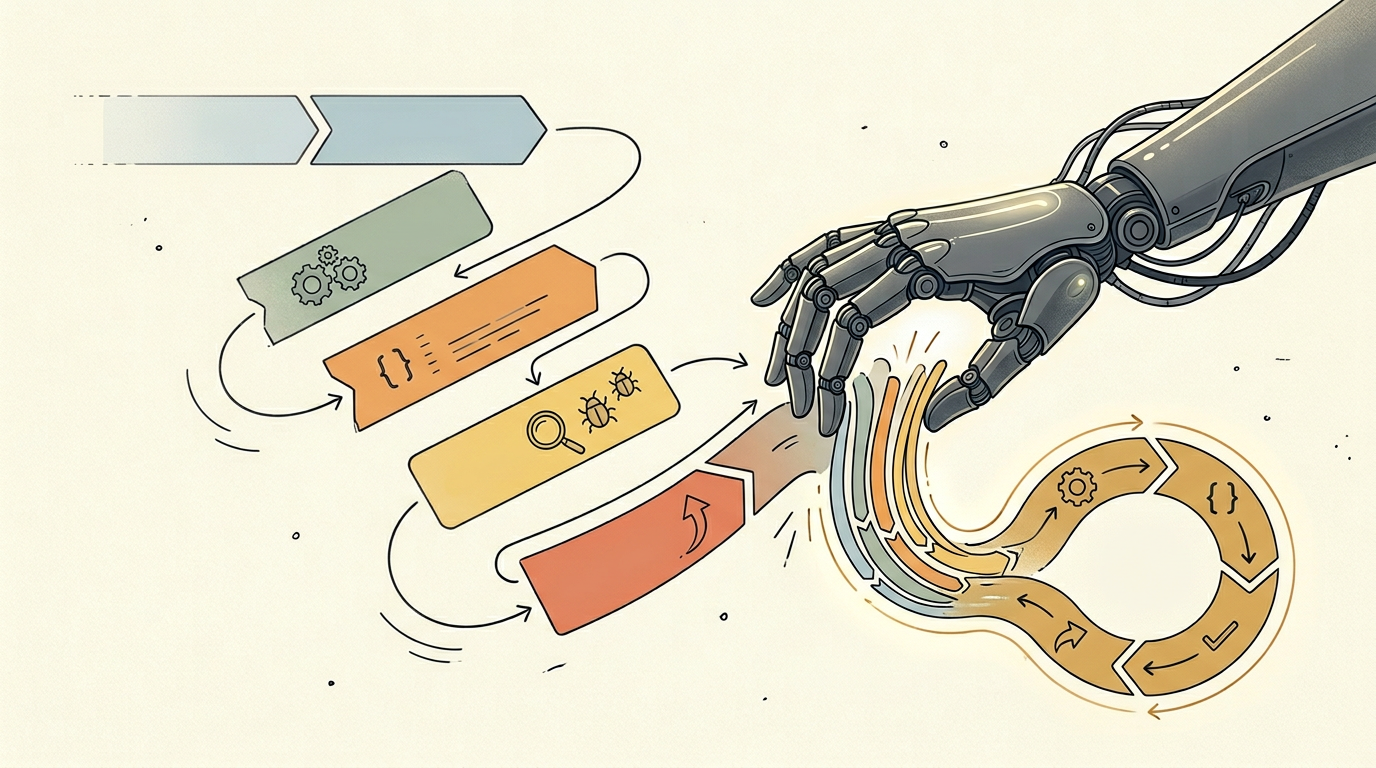
The traditional software development lifecycle — requirements, design, implementation, testing, deployment, maintenance — was designed for human limitations. Humans can only hold so much context, write so many lines per day, and review so many pull requests. AI agents have none of these limitations, and the SDLC is being restructured around what they can do.
Consider the historical context: the Waterfall model emerged in the 1970s when computing time was expensive and iteration was slow. Agile arose in the 2000s when web development enabled rapid iteration but teams still wrote code manually. We're now entering a third era where the cost of producing code approaches zero, and the entire framework needs to evolve again. Each paradigm shift was triggered by a fundamental change in the cost structure of software development — and AI agents represent the most dramatic cost reduction yet.
“From ideation to deployment in days, not months. How autonomous AI agents are compressing every phase of the SDLC.”
Requirements gathering used to mean weeks of meetings, user interviews, and specification documents. With AI agents, I describe the product in natural language and the agent asks clarifying questions, identifies edge cases I hadn't considered, and produces a technical specification in minutes. The specification isn't perfect, but it's an 80% starting point that would have taken days to produce manually.
Code review, traditionally a bottleneck in the development pipeline, is being transformed from both sides. AI agents write code that is often more consistent and well-structured than human-written code, reducing the surface area for review. Simultaneously, AI-powered review tools can analyze pull requests for security vulnerabilities, performance regressions, and architectural inconsistencies faster and more thoroughly than human reviewers. The human reviewer's role is shifting from 'does this code work correctly?' to 'does this code solve the right problem?' — a higher-level, more valuable form of review.
Design and implementation are merging. AI agents don't separate 'planning the code' from 'writing the code' the way human developers do. An agent given a feature description will simultaneously design the API, implement the logic, write the tests, and handle error cases. The cognitive separation between design and implementation — which exists because humans need to plan before executing — becomes unnecessary.
Architecture decisions — the most consequential and difficult part of software engineering — are where AI agents currently provide the most nuanced assistance. Given a set of requirements, an agent can propose multiple architectural approaches, articulate the trade-offs of each, and even simulate the implications of each choice over time. When I described I Love Hwarang's requirements to Claude, it correctly identified that the fundraising analytics would eventually outgrow Firestore and recommended PostgreSQL from the start — a prediction that proved accurate based on my own experience migrating a similar system.
Testing is where AI agents have the most dramatic impact. Writing tests is tedious work that humans consistently underinvest in. AI agents don't experience tedium. Given a function, an agent will generate comprehensive test cases — happy paths, edge cases, error conditions, boundary values — in seconds. The test coverage I achieve with AI agents is consistently 2-3x what I achieved writing tests manually.
Documentation, the perennial afterthought in software projects, becomes a natural byproduct of AI-driven development. Because AI agents work from natural language descriptions, the conversation history itself serves as living documentation. I've started treating my AI interaction logs as design documents — they capture not just what was built, but why it was built that way, what alternatives were considered, and what constraints drove the decisions. This represents a fundamental shift from documentation as a separate chore to documentation as an inherent artifact of the development process.
Deployment and maintenance are the next frontier. Today, AI agents can write code and run tests, but deploying to production and monitoring live systems still requires human oversight. This is changing fast — MCP-based agents can already interact with deployment pipelines, read logs, and diagnose issues. The gap between 'code that passes tests' and 'code running in production' is shrinking.
Team structures are already adapting to this new reality. The traditional ratio of 5-8 engineers per engineering manager was calibrated for human coding productivity. When each engineer is 3-5x more productive with AI agents, smaller teams can tackle larger projects. I'm seeing startups that would have needed 10 engineers ship with 3, and established companies reassigning engineers from implementation to product strategy, system design, and user research. The 10x engineer is no longer a mythical figure — it's anyone who has learned to direct AI agents effectively.
The most important shift is psychological, not technical. When code is cheap to produce, the bottleneck moves from 'can we build this?' to 'should we build this?' Product thinking — understanding users, identifying problems worth solving, evaluating trade-offs — becomes the scarce, valuable skill. The engineers who thrive in the AI era won't be the fastest coders. They'll be the clearest thinkers.
For developers wondering how to prepare: start using AI agents in your daily workflow now, not as novelty but as your primary development tool. Learn to write precise, context-rich prompts. Develop intuition for when to trust agent output and when to intervene. Invest in understanding system design, user experience, and product strategy — these are the skills that compound when code generation is automated. The developers who resist this transition won't be replaced by AI; they'll be replaced by developers who use AI. The transition is not coming — it's already here, and the gap between AI-augmented and traditional development velocity widens every month.
The traditional software development lifecycle — requirements, design, implementation, testing, deployment, maintenance — was designed for human limitations. Humans can only hold so much context, write so many lines per day, and review so many pull requests. AI agents have none of these limitations, and the SDLC is being restructured around what they can do.
Consider the historical context: the Waterfall model emerged in the 1970s when computing time was expensive and iteration was slow. Agile arose in the 2000s when web development enabled rapid iteration but teams still wrote code manually. We're now entering a third era where the cost of producing code approaches zero, and the entire framework needs to evolve again. Each paradigm shift was triggered by a fundamental change in the cost structure of software development — and AI agents represent the most dramatic cost reduction yet.
Requirements gathering used to mean weeks of meetings, user interviews, and specification documents. With AI agents, I describe the product in natural language and the agent asks clarifying questions, identifies edge cases I hadn't considered, and produces a technical specification
...
Tags: AI, MCP, Future of Work, Engineering
Key Facts
- • Category: Life
- • Reading time: 18 min read
- • Technology: AI
- • Technology: MCP
- • Technology: Future of Work