Mobile App · Filed · Comprehensive technical report
Flashcards Alarm
Alarm-driven flashcard study with AI content generation and spaced repetition.
Now Available
Download & Play
I. Product Thesis
Learning should be habitual, not optional. By embedding a vocabulary quiz into the daily alarm routine, retention becomes automatic—users don’t choose to study, they study because the alarm won’t stop until they answer correctly. A 3-stage backup chain ensures the quiz can’t be bypassed by force-quitting. New users often abandoned the app when their word list was empty; a short AI-driven placement quiz after signup fills that gap with five level-matched starter words so the app feels usable from minute one. Combined with AI-powered content generation via Gemini and spaced repetition, every morning starts with meaningful practice. This entire app was built 100% by AI—from architecture decisions to every line of shipping code, using Claude Opus 4.6 as the engineering team.
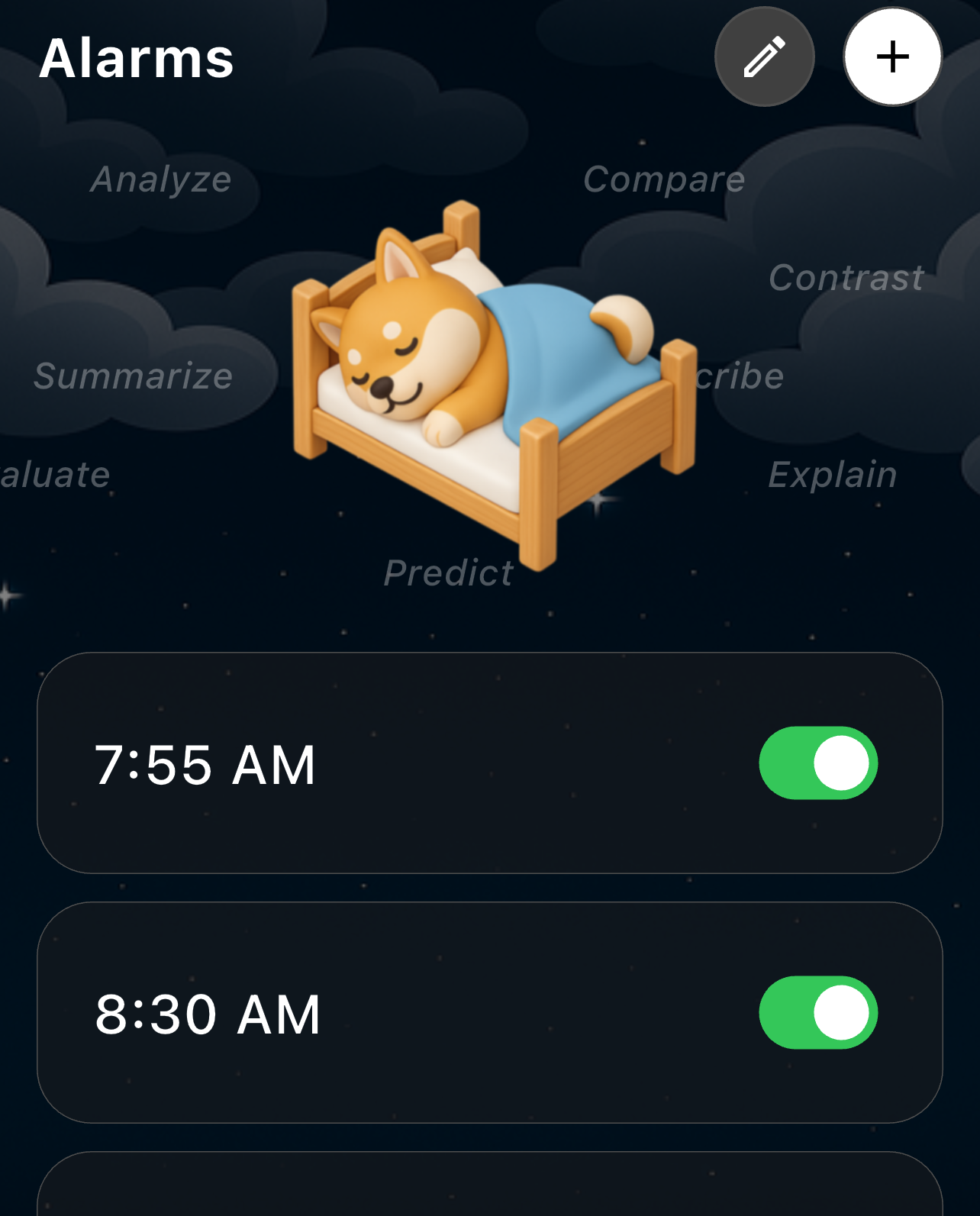
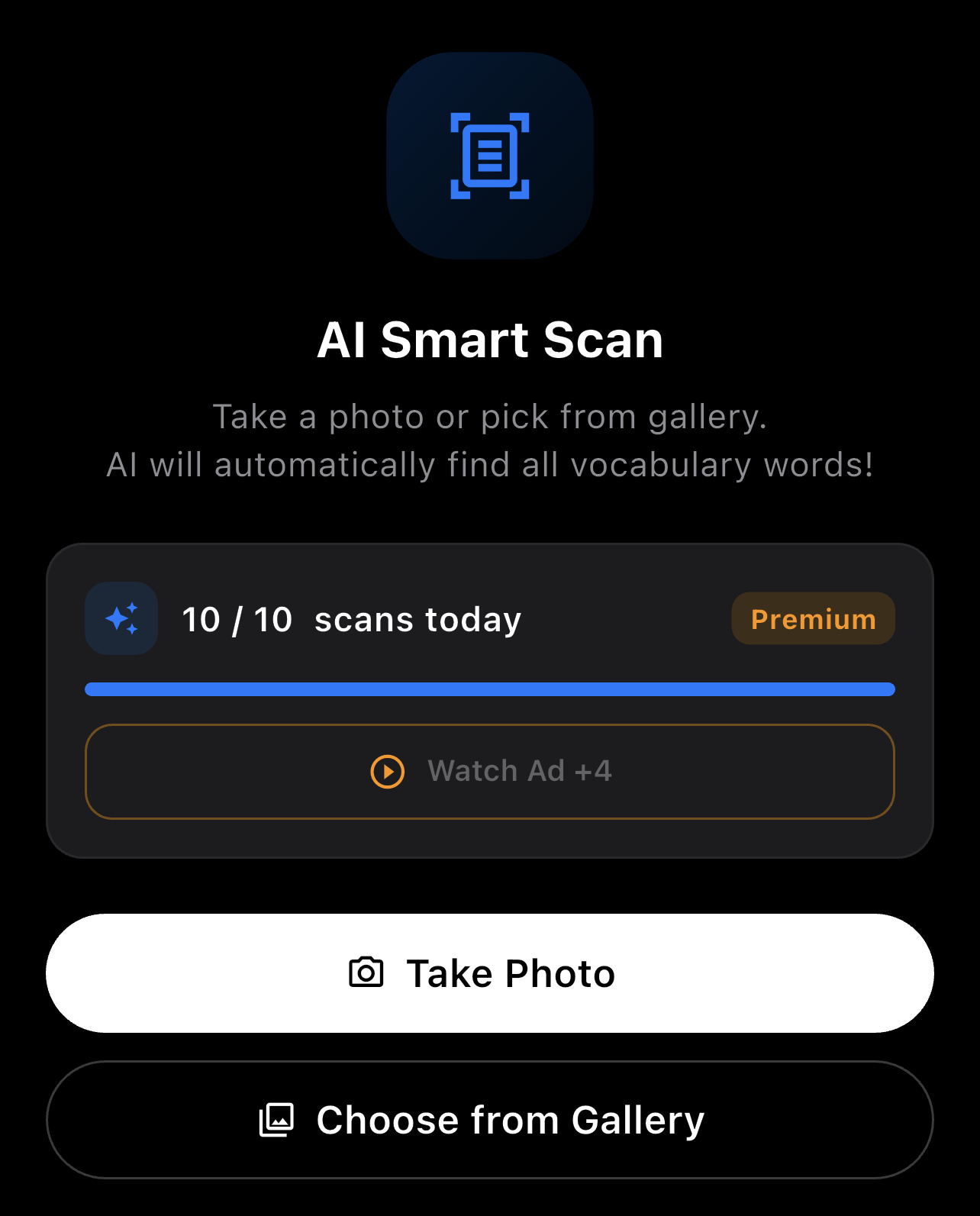
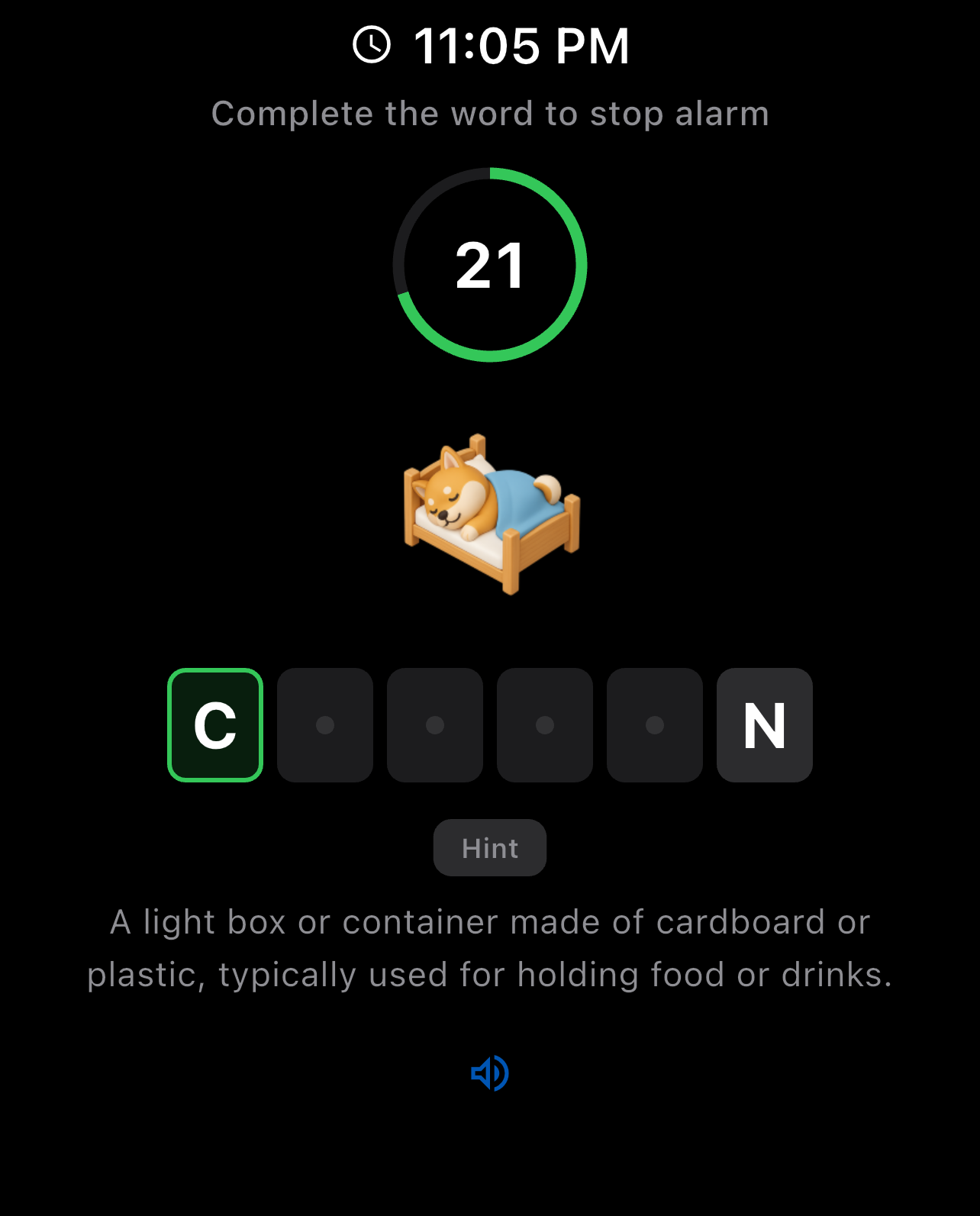
After sign-up, new users pick the language they want to study and the app’s main interface language, then complete a five-question vocabulary placement quiz. Each item is AI-generated; difficulty ramps up after correct answers and steps down after mistakes so the session stays challenging without punishing early errors. Results determine five starter words that Gemini recommends at an appropriate level—those cards land in the user’s library immediately so the deck is never empty on first launch. From there, set alarms with time and repeat days. When an alarm fires, a 30-second word quiz appears—letters reveal progressively, and the user must type the correct answer to dismiss. If the quiz isn’t solved, backup alarms fire at 5, 3, and 2 minute intervals. Between alarms, browse flashcards organized by groups, study by swiping cards (right for Know, left for Don’t Know), or use AI Smart Scan to photograph a textbook page and extract vocabulary automatically. Gemini generates definitions in the background. The spaced repetition engine surfaces cards at optimal intervals based on mastery level—6 levels with intervals from 1 to 30 days. Track progress through stats with 7-day charts and mastery distribution.
II. Built Surface — Shipped Features
First-session placement quiz: after choosing study language and app UI language, five AI-generated vocabulary questions with adaptive difficulty (harder after correct answers, easier after misses)
Starter deck seeding: AI selects five words matched to the user’s inferred level from the quiz and adds them to the word list so alarms and study work on day one
Alarm-triggered 30-second word quiz with progressive letter reveal to dismiss
AI Smart Scan: camera-based vocabulary extraction from textbooks via Gemini vision
Spaced repetition with SM-2-style algorithm — 6 mastery levels, intervals from 1 to 30 days
AI-generated definitions and automatic word categorization via Gemini
3-stage backup alarm chain (5 min → 3 min → 2 min) to prevent quiz avoidance
Offline-first with Firestore persistence and locally queued quiz results
Home screen widgets (iOS SwiftUI + Android Kotlin) showing review progress and next alarm
Flashcard study with swipe-to-rate — Know / Don’t Know updates mastery
Study analytics with 7-day bar charts, mastery distribution, and streak tracking
Multi-language support across 9 locales (EN, KO, JA, ZH, ES, FR, DE, PT, ZH-TW)
Weak Course and Confusion Pairs for targeted review of struggling words
100% AI-generated codebase via Claude Opus 4.6
III. Engineering — How the System Holds Together
Flutter handles the cross-platform UI with Provider for state management. Alarms use the native alarm package for reliable background scheduling on iOS 13+ and Android—audio plays even when the app is killed or locked. A 3-stage backup chain (5 → 3 → 2 minutes) persisted to SharedPreferences ensures the quiz can’t be bypassed by force-quitting. Flashcards, groups, and quiz results live in Firestore with unlimited cache enabled for offline-first operation—pending quiz results queue locally (up to 100) and sync when connectivity returns. All AI features—definitions, Smart Scan, word categorization, onboarding placement questions, and starter-word selection—run client-side via the firebase_ai SDK connecting directly to Gemini 3 Flash with no Cloud Functions in the stack, eliminating server costs and cold starts. Spaced repetition uses a custom SM-2-style algorithm with 6 mastery levels and fixed intervals (1, 2, 4, 7, 14, 30 days). Home screen widgets use SwiftUI on iOS and Kotlin on Android, reading shared data through app group UserDefaults and SharedPreferences.
“Learning should be habitual, not optional.”
IV. Key Editorial Decisions
Flutter over native for single-codebase efficiency across iOS and Android, accepting the trade-off of more complex alarm scheduling via the alarm package’s native bridge.
Client-side AI via firebase_ai SDK over Cloud Functions—eliminates server costs and cold starts, but requires the device to handle Gemini requests directly.
Adaptive five-question onboarding quiz plus AI-seeded starter words to fix empty-deck abandonment—perception of ‘nothing to do’ was driving churn faster than lack of motivation.
3-stage backup alarm chain (5 → 3 → 2 min) to make quiz avoidance practically impossible—aggressive but aligned with the core promise of mandatory study.
Offline-first with Firestore unlimited cache and local quiz result queue—alarms and quizzes must work without connectivity since they fire at wake-up time.
Technical Specifications — Complete Dossier
Status
FILED
Category
Mobile App
Bureau
Los Angeles
Technologies
Flutter, Firebase, Gemini AI, Claude Opus 4.6
Co-Creator
THE JK JUNG TIMES · End of Full Report · All the code that's fit to ship.